
 Junior Student’s Corner
by Sifu Charlie Romeo
Fu For You Fall 2026
Back in 2024, I wrote two articles about the weapons we use along the journey to black sash. Before jumping in here, I suggest revisiting the previous Junior articles, Weapons 101: Weapons Are Not Toys and Weapons 102: Revisiting Previous Weapons, to refresh your memory. Having already discussed the importance of the correct mindset when wielding weapons and understanding their deeper details, we can now turn our attention to how to build skill with weapons as you continue your practice.
The first step in learning a new weapon is simply picking it up. You can research its technical aspects as much as you’d like, but you won’t truly understand how a weapon feels until you hold it. In Weapons 101, we discuss finding an open space to shadowbox with your weapon and allowing your movements to flow naturally. This helps you get used to its ‘feel’ while understanding its weight distribution and exploring the different ways it can be wielded. Just as we teach you to shadowbox before learning to spar, it’s a good idea to shadowbox with your weapon before learning a new form or sequence. Practice your speed and accuracy, as well as the subtleties of your grip, guard, and chambered position. To build true skill, you first need these strong foundations.
Understanding the feel of your weapon is only one part of developing skill; you also need to understand its construction and mechanics. For example, do you know which parts of the Chinese broadsword are sharp and which are dull? The answer may not be as obvious as it seems. To build skill, you need to understand the function of each part of the weapon so you can use it to its full potential. How can you block with a tonfa? Which grips are most practical for overhead versus upward strikes with a staff? Skill comes from understanding the most practical and effective ways to wield a weapon—not simply following the movements you’re taught.
Some weapons are highly versatile; like the staff, for example. Its extended range makes it effective against weapons like the tonfa, daggers, or broadsword, when wielded with skill. Other weapons are particularly strong in certain matchups, and weaker in others. The sai, for example, is particularly well suited to defending against bladed weapons like the Chinese broadsword. Its side prongs can trap or deflect an incoming blade, while the center prong provides a strong structure for blocking and controlling an opponent’s weapon.
On the other hand, the sai is less effective against daggers. Their short blades are difficult to trap, and their close-range mobility forces a confrontation in the dagger’s strongest range. Understanding each weapon’s strengths and weaknesses is key to developing your skill and knowledge.
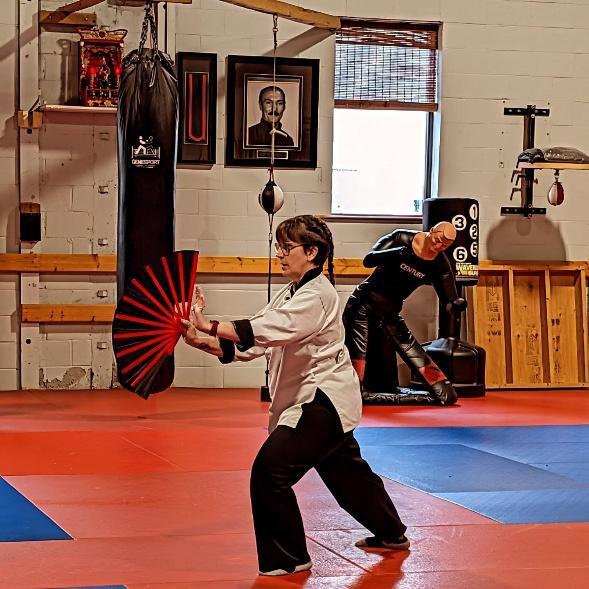 We’ve discussed how to adopt the right mindset when using weapons, how to improve your technique and deepen your understanding, and now, how to build real skill. As you advance, weapons will become a bigger part of your regular training, so take the time to build skills that will carry over into other areas of your practice.
See all of the articles about Kung-Fu Weapons, including: